Brokerage & Trading
Top 10 Forex Technology Providers and White Label Vendors in 2026
Date:
04.05.2026
Finding the Right FX Technology Partner
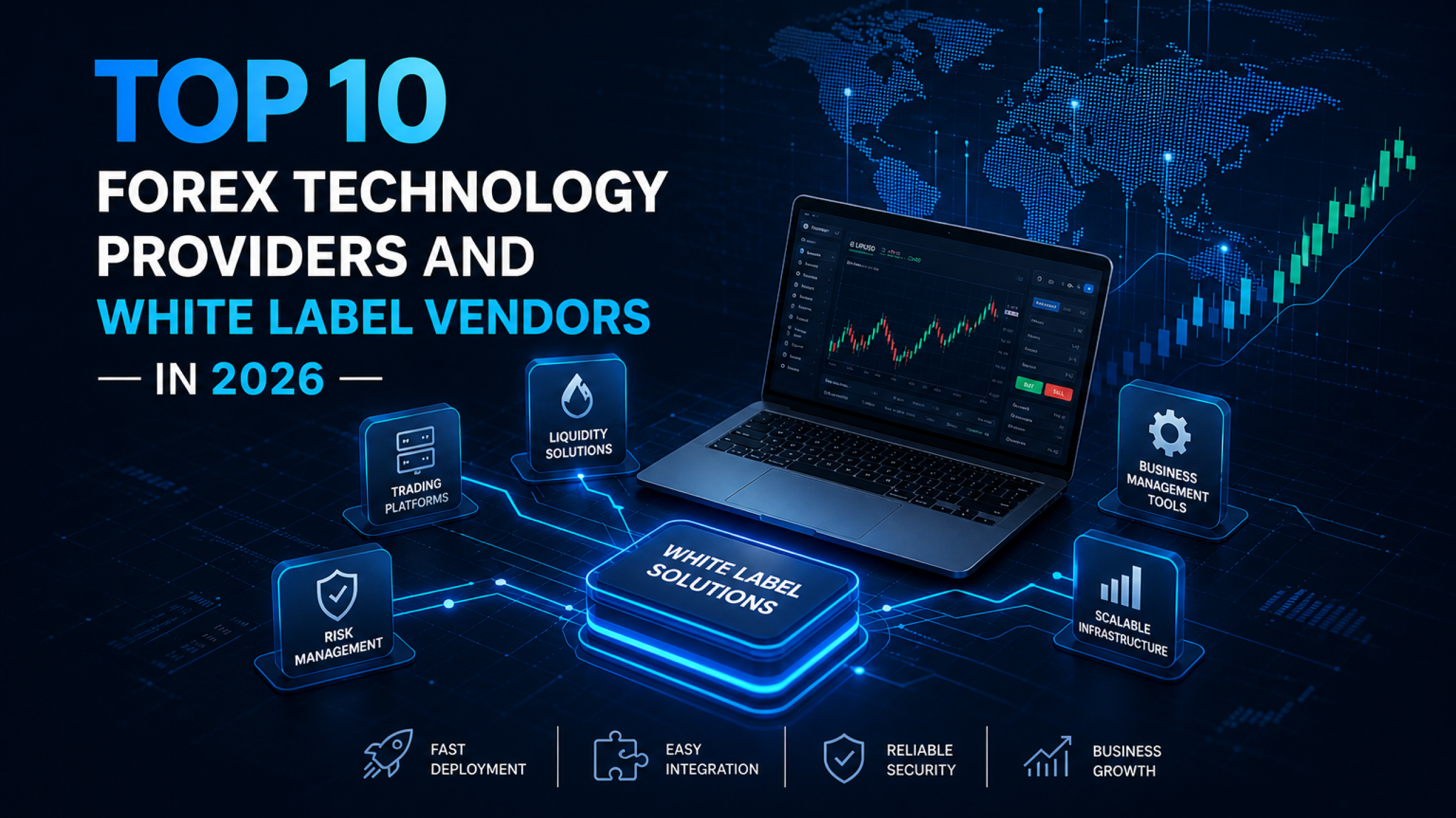
Building in-house trading systems is becoming less necessary as forex technology providers take over core infrastructure. What once required large development teams, significant capital investment, and long deployment cycles can now be implemented within a week through ready-made solutions, typically including access to advanced trading platforms and liquidity, risk management tools, and a key business management ecosystem.
Today, the market for white label forex solutions is full of vendors claiming to be the best providers. Their packages often look similar on the surface, but differ significantly in scalability, integration options, and operational reliability. This article provides an overview of the most popular FX technology vendors and aims to help you choose the most suitable solution for your business, rather than promoting a single “best” option.
What Is a Forex Technology Provider?
The term refers to a company that supplies the core systems required to operate a brokerage business. Instead of building complex infrastructures internally, brokers rely on these providers to roll out a ready-to-use technology stack required for trading operations, fast execution, and process management. In a standard setup, it includes:
-
Trading platforms: Integration of the MT5/4, cTrader, or proprietary solutions that allow traders to place and manage trades.
-
Liquidity connectivity: Access to liquidity providers and aggregation systems that ensure competitive pricing and market depth.
-
Execution systems: A solution that processes and routes orders with low latency and reliable performance.
-
Brokerage infrastructure: CRM systems, back-office tools, reporting dashboards, and client management systems.
In simple terms, a forex technology provider develops the technical foundation for brokerage firms. Depending on its specialization, the level of product complexity can vary significantly — from plug-and-play solutions with basic platform access to highly customizable, enterprise-grade systems that support fully integrated management ecosystems.
What Is a White-Label Forex Solution?
A white label approach is a way to quickly access the services of forex technology vendors by using their ready-made infrastructure. It enables companies to start operations with pre-built technology rather than hiring teams of specialists and developing everything from scratch.
The main advantages of this approach are its customization options and the freedom to operate under your own brand, which allows you to incorporate features that are important to your customers and expand your base of loyal users. Companies can adjust trading conditions, configure client onboarding flows, and tailor operational settings without modifying the underlying technology. Most providers also include technical support, maintenance, and regular updates, reducing the need for an in-house development team.
Compared to building a platform internally, a white-label forex solution is far more resource-effective as it doesn't require significant time, technical expertise, and budget. In-house development can take months, while a white-label forex solution enables brokers to start working and attract their first client within weeks.
Key Criteria for Choosing a Forex Technology Provider
The key factors below help evaluate whether a provider’s offering truly matches your operational model and long-term growth strategy. They go beyond reviewing basic functionality because you should focus on assessing how well the technology performs in real trading conditions, how easily it integrates into your existing infrastructure, and whether it can scale.
Execution Speed and Latency
Execution speed determines how quickly client orders are processed and filled. A strong technology developer will deliver low-latency infrastructure, optimized order routing, and stable performance during market volatility.
Review the provider’s hosting setup, including data center locations and proximity to liquidity providers. It is also useful to request latency benchmarks, test execution in a demo environment, and analyze slippage and rejection rates.
Trading platform compatibility
Trading platform compatibility defines which platforms the provider supports and how easily they integrate into the brokerage infrastructure. Popular solutions such as MT4, MT5, and cTrader attract different trader segments, so offering multiple options can expand the forex market reach.
Check which platforms are supported and whether multi-platform deployment is possible. If you choose a provider with their own platform, it is also important to review its stability and update management.
Compliance and security
These parameters are critical for maintaining regulatory alignment and protecting client data. A reliable vendor should support KYC and AML workflows and provide secure data storage and audit-ready reporting tools.
Evaluate available compliance features, data protection policies, and access control mechanisms. In addition, you can check whether the provider offers system monitoring, encryption, and role-based permissions.
Scalability
Scalability determines whether the technology is able to expand smoothly without requiring major system changes. As trading volume increases and new regions or client segments are added, the platform should maintain stable performance and allow brokers to implement new trading instruments, liquidity connections, and grow operational capacity.
To assess scalability, ask to demonstrate infrastructure architecture, including load balancing and modular components. If a solution supports multi-account structures, multi-asset expansion, and the ability to add integrations, like extra payment gateways, it allows the business to expand without technical limitations.
API and Customization
API integration enables brokers to connect external services, creating a more flexible operational environment. Customization options allow adjustment of workflows, branding, and trading conditions to match a specific business model. Together, these capabilities help build a tailored brokerage setup aligned with long-term strategy.
Examine the range of available APIs and the ease of their implementation. It is also important to assess how much control the provider offers over branding, user permissions, trading configurations, and client workflows.
Top 10 Forex Technology and White-Label Providers
Choosing the right technology vendor is a strategic decision that directly impacts performance and profitability. In our guide below, we gathered the 10 best forex providers to help you understand how their offerings differ.
Wifox
Our company provides a modular brokerage software solution that combines trading technology, CRM, client area, and operational tools. The white label solution focuses on fast deployment, workflow customization, and unified management for brokers launching or scaling operations. It supports multi-project setups and flexible integrations.
Key advantages:
-
Unified operational workspace
-
Flexible customization and branding
-
Scalable architecture for growth
-
Fast deployment timelines
-
Built-in compliance workflows
Best suited for:
Brokers looking for an all-in-one infrastructure with strong customization and operational control.
B2ROKER
B2BROKER is a well-known fintech company that offers a wide range of products, including liquidity aggregation, white label solutions, including PAMM and MAM platforms, and brokerage infrastructure. Its services are designed to support businesses at different stages, from initial setup to scaling trading operations.
Key advantages:
-
Strong industry reputation
-
Institutional-grade infrastructure
-
Wide partner hub and range of products
Best suited for:
Mid-size to large brokerages seeking all-encompassing solutions and a reputable service provider.
XTX Markets
XTX Markets delivers tailored liquidity with low market impact to banks, asset managers, hedge funds, and retail brokers across multiple markets and multiple asset classes, including FX, commodity, metals, NDFs, and U.S. and European equities. The firm leverages advanced quantitative research and machine learning technology to deliver precise pricing, deep liquidity across thousands of assets, and reliable trade execution even during volatile market conditions.
Key advantages:
-
Deep liquidity pools
-
Strong execution performance
-
AI-driven algorithmic trading expertise
Best suited for:
Designed for serving institutional clients with complex liquidity management needs.
LMAX Group
LMAX Group is a global financial technology company that builds and runs its own ultra-low-latency exchange infrastructure. Its ecosystem includes institutional exchange for global FX, crypto trading venues, and brokerage services.
Key advantages:
-
Transparent, regulated trading environment
-
Institutional-grade trading infrastructure
-
Multi-asset coverage, including cryptocurrencies
Best suited for:
Institutions requiring regulated, transparent FX and multi-asset trading access.
oneZero
The provider offers multi-asset trading technology designed to support execution, distribution, and advanced analytics and market data across different asset classes. Also, they have a liquidity distribution hub that connects brokers, banks, and liquidity providers, offering access to unique order flow and direct market connectivity to exchanges and clearing providers.
Key advantages:
-
Flexible liquidity aggregation
-
Advanced risk controls
-
Strong client engagement solutions
Best suited for:
Designed for retail and institutional brokers and liquidity providers.
MetaQuotes
MetaQuotes is a well-known developer of leading forex trading platforms MT4 and MT5. Beyond these platforms, they offer a complete offering for brokerage operations, covering all critical components for seamless work. It also provides mobile trading applications, an algorithmic trading tool, and a strategy tester.
Key advantages:
-
Large base of loyal users
-
Extensive ecosystem
-
Proven stability
Best suited for:
Retail brokers and hedge funds looking for a widely recognized service provider with a complete management solution.
Match-Trade Technologies
Match-Trade Technologies offers white-label trading solutions, prop trading software, a copy trading app, and back-office tools for forex brokers. The company focuses on modular deployment. They also provide access to liquidity from institutional pools and support a variety of integrations.
Key advantages:
-
Modular infrastructure
-
Integrated CRM
-
Multi-asset support
Best suited for:
Small and mid-size brokers seeking liquidity and technology access in one solution.
Spotware Systems
Spotware Systems is the developer of the cTrader trading platform and cBridge solution that serves as a gateway to liquidity. The company provides trading technology used by brokers and liquidity providers to operate, connect, and scale their trading infrastructure.
Key advantages:
-
Advanced trading functionality
-
Strong API capabilities
-
Trusted reputation
Best suited for:
Businesses that need robust trading technology and connectivity solutions.
Integral
Integral FX technology provider that delivers an end-to-end platform for trading and workflow automation. Its solutions help banks, brokers, and financial institutions manage the full trading lifecycle, from pricing and distribution to risk management and analytics. Also, it offers FX white label solutions with centralized infrastructure and a high level of customization.
Key advantages:
-
Institutional-grade technology
-
High scalability
-
Advanced execution capabilities
Best suited for:
Institutional brokers and financial institutions.
SmartTrade Technologies
SmartTrade Technologies is a financial technology provider that delivers multi-asset trading and execution solutions for banks, brokers, and institutional clients. Its platform helps firms optimize order routing, improve execution quality, and manage complex trading workflows across global markets.
Key advantages:
-
Enterprise scalability
-
Multi-asset coverage
-
Advanced execution logic
Best suited for:
Large brokerages requiring scalable, enterprise-grade infrastructure
Forex Technology Trends in 2026
The forex landscape continues to evove, setting the rules for technology development. Understanding key trends helps select offerings that remain competitive in 2026 and beyond.
AI and Automation
AI-driven tools are becoming standard for brokerage products. Automated solutions support risk management, enable dynamic spread adjustments, enhance client segmentation, and strengthen fraud detection. Businesses choose AI-based software to respond faster to market changes and improve operational efficiency.
Algorithmic and automated trading growth
Algorithmic and automated trading continues to expand as both institutional and retail traders increasingly rely on automated trading strategies. This trend drives demand for low-latency infrastructure, stable execution, and support for APIs and advanced order types. Providers that enable algorithmic trading features help brokers attract active traders and support higher trading volumes, making this feature an important consideration when selecting a solution.
Crypto trading integration
As brokers diversify beyond traditional FX and CFDs, crypto trading integration is becoming an expected feature. Supporting digital assets requires access to cryptocurrency liquidity, secure custody options, and reliable pricing infrastructure. Seamless integration allows brokers access to new asset classes, broaden their product range, attract new client segments, and remain competitive in a multi-asset trading environment.
Mobile trading expansion
Mobile trading continues to grow as more traders prefer managing positions and monitoring markets on the go. This trend increases demand for responsive mobile platforms, stable performance, and full-featured functionality comparable to desktop versions. Robust mobile trading solutions help brokers improve client retention and engagement, enhance accessibility, and support trading activity across different devices.
5 Mistakes to Avoid When Choosing a Forex Provider
Many businesses focus on short-term factors and overlook critical requirements when selecting a forex tech provider. Here are 5 mistakes to avoid when making a final decision.
-
Choosing based on price alone: Unfortunately, low-cost solutions offer limited features. They often lack essential infrastructure, reliable liquidity solutions, or customization capabilities. While initial savings may seem attractive, hidden fees, poor execution, or missing features can increase operational costs later. This approach often results in migration expenses and business disruption.
-
Ignoring compliance requirements: Overlooking compliance tools such as KYC, AML, and reporting capabilities can create serious regulatory risks. Brokers may face difficulties working with payment providers or obtaining licenses. Weak compliance infrastructure can also damage credibility with clients and partners.
-
Poor technical support: Limited or slow support becomes critical during trading disruptions or system failures. Without responsive assistance, brokers risk downtime, execution issues, and client complaints. Reliable 24/7 support is essential for maintaining operational stability.
-
Lack of scalability: Some platforms work well for small operations but fail under increased trading volume. Limited scalability affects speed of execution, system stability, and user experience. Brokers may need to migrate to a new provider, which can be complex and costly.
-
Vendor lock-in: Certain vendors restrict integrations or make it difficult to migrate data. This reduces flexibility and prevents brokers from adding top liquidity providers or new services. Vendor lock-in limits strategic growth and increases long-term dependency on a single provider.
Selecting the right vendor requires weighing performance, flexibility, and long-term business goals. Request demos, test execution quality, and review available integrations to ensure the technology fits your operational workflows.
FAQ
1. What factors should I consider when choosing the best trading technology provider?
When looking for a trading tech provider, focus on practical factors such as liquidity sources, execution reliability, supported trading platforms, and its capability to scale. It is also important to evaluate integration options, infrastructure stability, and the availability of technical support. If you need institutional trading or high-frequency trading options, check their presence in advance. These elements help ensure the technological solution can support business growth without performance issues or operational disruptions.
2. How do liquidity aggregators enhance forex trading efficiency?
Liquidity aggregators combine quotes from multiple liquidity providers into a single pricing stream. This setup helps improve spreads, increase available volume, and reduce slippage during volatile market conditions. In practice, better pricing and execution quality enable brokers to offer more competitive trading conditions and improve client satisfaction.
3. What are the risks associated with using automated forex trading systems?
Automated forex trading systems become more popular due to their convenience; however, they can create risks if they are not properly configured or monitored. Technical failures, latency issues, or incorrect algorithm settings may lead to execution errors or unexpected losses. You have to set proper monitoring and risk controls to maintain system stability.
4. How does regulatory compliance impact the services of a forex trading technology provider?
Regulators, like FCA or CySec, define industry requirements that businesses must comply with, including strict KYC, AML procedures, and transaction reporting. These controls help ensure proper client onboarding, continuous monitoring, and audit compliance. Strong compliance capabilities help secure banking and payment partnerships, while gaps may restrict licensing and expansion.
5. When does it make sense to use white-label forex solutions instead of in-house development?
Each business has its own priorities when launching a business. Typically, these are time to market, budget, and scope of work. White-label solutions are preferred when brokers need to gain direct market access with low costs. Building in-house systems is better suited to companies with strong technical teams and sufficient resources to support long-term development, maintenance, and continuous upgrades.
Bottom Line
There is no one-fits-all solution when it comes to choosing a forex infrastructure provider. Each brokerage has different needs and requirements for liquidity, execution quality, regulatory scope, and set of features, which means the right choice always depends on business context rather than market rankings. The key factor to consider is the strategic fit between the provider’s technology and the broker’s operational model.
Technology is no longer just support infrastructure; it directly impacts business performance and ultimately affects revenue and the ability to scale. For this reason, provider selection should be treated as a strategic business decision rather than a technical choice.
digitize your
digitize
your
Business
today!
Unlock your potential with our powerful core solution, completely free!


