Integrations
Back-Office CRM for Forex Brokers in 2026: Ops Framework (Trader Room, IB Portal, Payments)
Date:
25.02.2026
In the 2026 brokerage landscape, founders and operations leads must move beyond superficial sales tools to build a robust operational layer that integrates onboarding, payments, and compliance. Selecting a system that acts as a central nervous system is critical for scaling without internal friction or regulatory delays. This forex CRM guide is designed to move past superficial sales decks and focus on what it actually takes to run a high-growth brokerage in 2026.
TL;DR: The 3-Layer Operational Framework
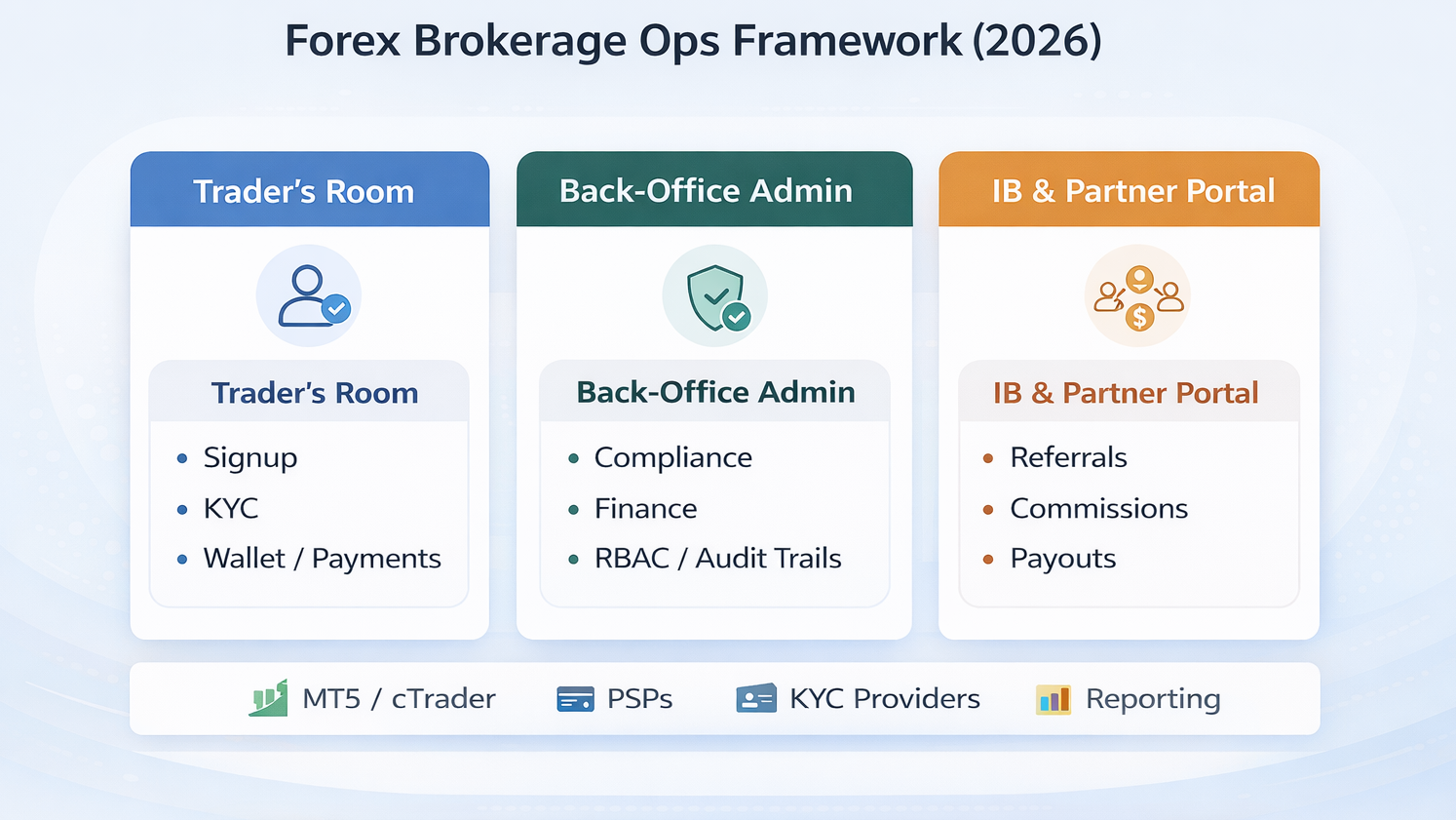
A modern brokerage environment is judged as a single ecosystem consisting of three perfectly synced layers.
Trader’s Room
Core function: Mobile-first registration, KYC uploads, and wallet management
Primary stakeholders: Clients / Traders
Back-Office Admin
Core function: “Management by Exception,” identity verification, and withdrawal oversight
Primary stakeholders: Compliance, Finance, Ops
IB & Partner Portal
Core function: Self-service referral tracking and real-time commission payouts
Primary stakeholders: Affiliates / Partners
CRM/back-office value depends on tight integration with the trading platform, payments, KYC, and reporting. If those links are weak, even a great UI turns into manual work, delays, and blind spots.
1) Operational Evidence: This guide provides concrete benchmarks for KYC and payment workflows.
2) Implementation Notes: Includes a roadmap for roles, data migration, and identifying launch risks.
3) Comparison Framework: Offers a method to vet a forex broker CRM for 10,000+ clients.
What a Forex CRM Really Means in 2026
In 2026, a CRM is no longer just a lead database; it is your back-office CRM for brokers. It serves as the bridge between your trading platforms, payment gateways, and regulatory reporting obligations.
1) The Trader’s Room (Client Cabinet): This is the only part of your infrastructure the client "lives" in. It must be a frictionless experience where traders can manage accounts and move money without switching to desktop for basic tasks like utility bill uploads.
2) The Back-Office Admin System: This is the command center where compliance and finance teams live. High-quality systems focus on "Management by Exception," highlighting only the accounts that require human intervention.
3) The Partner and IB Portal: IBs expect a "self-service" model to generate tracking links and see downline volume in real-time without manual intervention from your team.
Explore the Wifox Trading Solution to see how trading infrastructure connects with CRM and back-office workflows.
Why the "Core Banking" Mindset is Non-Negotiable
The industry is moving away from "Sales-First" tools toward a core banking forex CRM approach that prioritizes ledger integrity and bank-level rigor.
1) Transaction Visibility: Every dollar, euro, or bitcoin requires a perfect audit trail.
2) Role-Based Access Control (RBAC): Permissions must be granular; for example, a sales agent in one region should not be able to view the withdrawal history of a client in another.
3) Audit Trails: Regulators require proof of who approved an account and which documents were reviewed at that exact moment.
Pressure Points: Speed and Compliance Evidence
Generic CRMs fail because Forex requires deep technical integration and handles high-volume, regulated traffic.
1) The Need for Speed: "Instant" is the baseline standard for 2026. If a client deposits via a local payment method, the balance must appear in their account immediately. Professional systems aim to approve low-risk segments in under 5 minutes using automated API integrations for verification.
2) The Compliance Weight: Regulators now demand to see the full workflow, not just the result. A specialized forex broker CRM runs names through Sanctions and PEP lists automatically, so compliance teams only focus on "gray" cases.
3) Scaling with a Multi-Brand CRM: Groups running an offshore entity alongside a regulated EU brand need a multi-brand CRM to manage all entities from one "master" admin panel. This allows shifting staff resources and viewing global volume without repeatedly logging in and out.
Implementation Notes: Roadmap for Launch
Deploying a forex broker CRM is an operational overhaul that requires cross-departmental coordination.
1) Ops: Defines the end-to-end client journey from signup to withdrawal.
2) Compliance: Configures the automated KYC gates and risk flags.
3) Finance: Manages PSP routing and "Auto-Approve" rules for small withdrawals, such as those under €500 for trusted clients.
4) Support: Integrates communication tools into a unified activity timeline.
5) Data Migration Needs: You must map historical trading data, client KYC documents, and IB hierarchies.
6) Common Launch Failures: Most systems fail due to poor data mapping or staff retreating to "side spreadsheets" because the new admin workflows weren't properly role-configured.
Conducting a Forex CRM Comparison: The 2026 Framework
When performing a forex CRM comparison, move past flashy dashboards and ask how the system handles 10,000+ clients.
1) Scalability: Look for cloud-native, auto-scaling with 99.99% uptime rather than basic volume handling.
2) Multi-Brand: Prioritize single-sign-on (SSO) admin for all brands over multiple logins.
3) KYC/AML: Require full API sync with liveness checks rather than manual uploads.
4) Reporting: Ensure real-time BI with "scheduled" automated reports.
5) IB Logic: Demand dynamic, tiered logic with instant payouts.
FAQ: Brokerage Operations & CRM
1) What is a back-office CRM for forex brokers?
It is the operational "brain" that integrates client management, KYC, payments, and trading account management into a single administrative view.
2) What is bi-directional sync with MT5 / cTrader?
It means information flows both ways instantly. If the CRM blocks an account for compliance, the platform locks it immediately.
3) How long does a default go-live take?
While simple setups take days, a full migration with historical data and custom PSPs typically takes 4–8 weeks.
4) What’s the minimum RBAC set for a brokerage?
At a minimum, separate roles for Sales (leads), Compliance (KYC), Finance (withdrawals), and Super-Admin.
5) Can you run multi-brand with data segregation?
Yes. A true multi-brand CRM keeps the data for separate brands separated for legal reasons while offering unified group reporting.
6) What should I ask on a CRM demo to validate payments?
Ask to see the "Pending" withdrawal workflow and how the system handles a callback from a failed local payment method.
Conclusion: The Path to Growth
In 2026, a CRM is a strategic decision that dictates your scaling speed. When systems are integrated and workflows are automated, your team is free to focus on building relationships and growing your AUM.
If you want to validate these workflows in a live environment, book a Wifox demo and test real brokerage scenarios.
Demo Wifox to review:
1) Trader Room and onboarding flow
2) KYC and compliance workflows
3) payment and withdrawal operations
4) IB portal and commission logic
5) role-based permissions and audit trails
digitize your
digitize
your
Business
today!
Unlock your potential with our powerful core solution, completely free!


